Random fault injection is not resilience engineering.
Resilience is not discovered by breaking things randomly. It is built by understanding where failure concentrates before it reaches production.
Software Signal Engineering maps your dependency field, models failure propagation probabilistically, and selects only the experiments that reveal real structural risk.
Measurable Chaos Engineering Impact
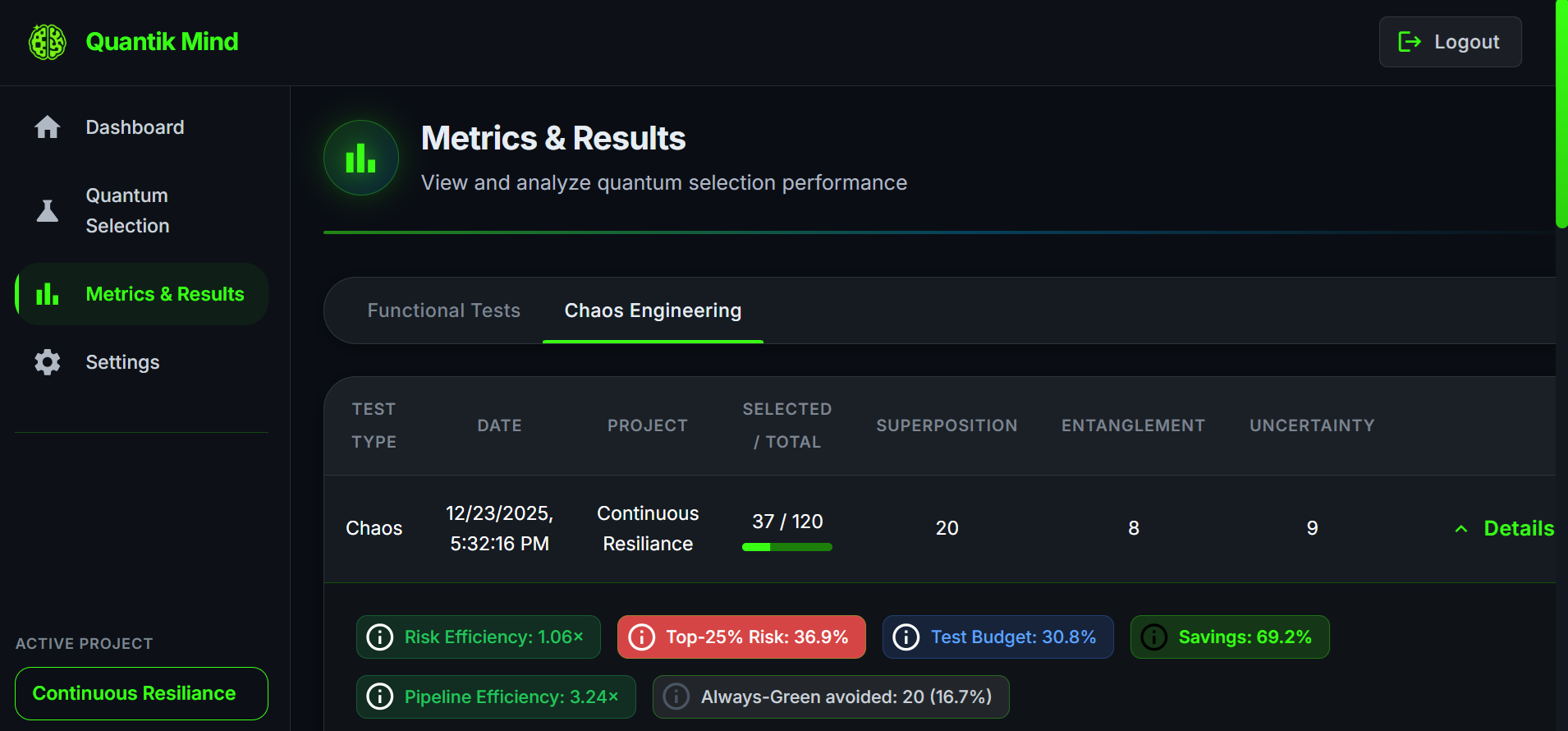
Selection-only metrics: coverage, focus, risk exposure, and expected resilience improvements
Hypothesis before injection. Intelligence before blast radius.
Chaos without direction is theater. Quantik Mind treats resilience engineering as a probabilistic discipline: every experiment is a hypothesis, every result is signal.
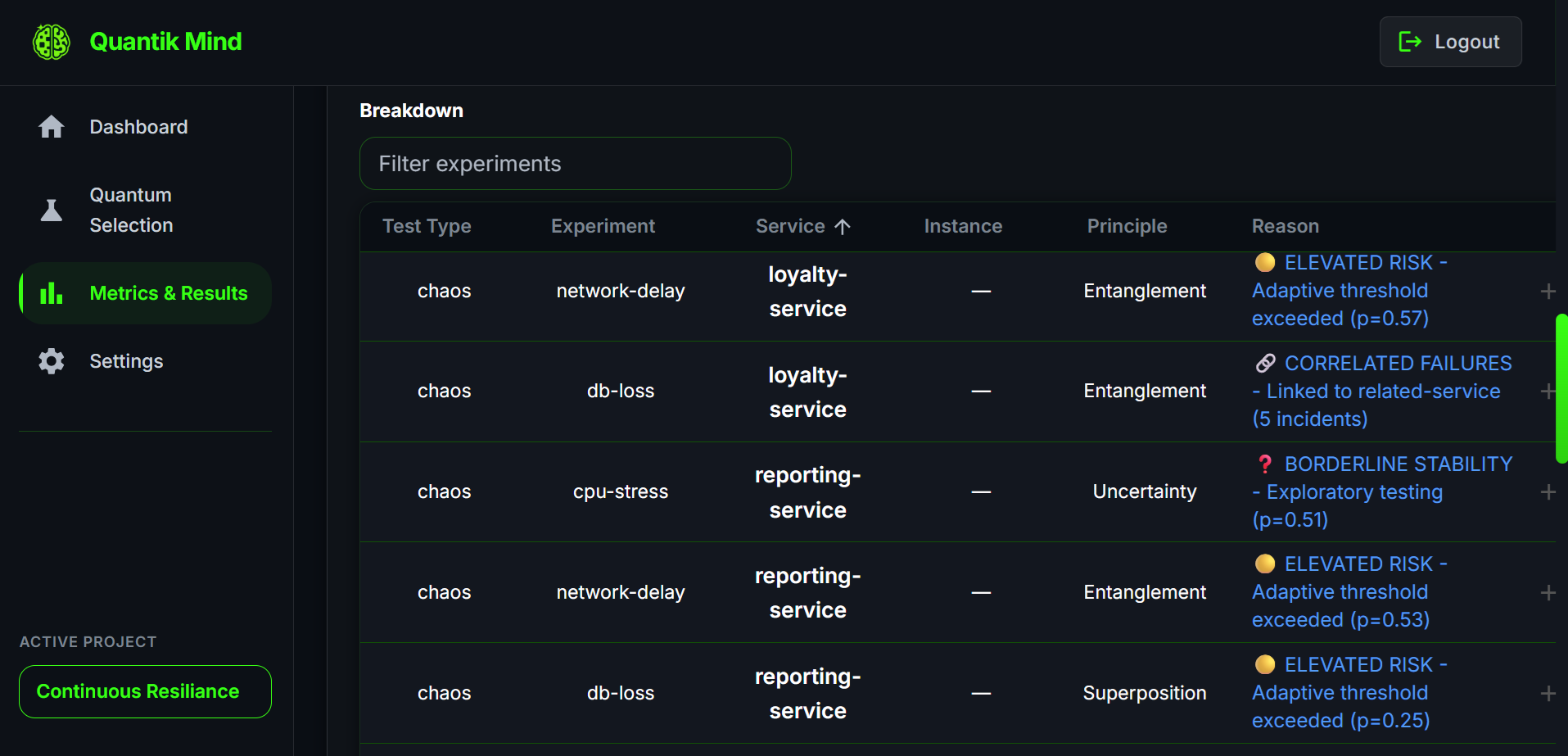
Signal over noise: Fewer random breaks, more validated failure modes, faster learning cycles. Each recommendation includes what to break, why, expected signals, and suggested fixes, plus an expected resilience score you can track release after release.

Entanglement is not a bug.
It is the map.
Hidden dependencies are where resilience collapses. The engine maps cross-service entanglement, models failure propagation, and surfaces the paths that matter before they matter.
Fewer assumptions. Greater confidence under stress. No unpleasant surprises.
Signal-driven resilience engineering.
Not random fault injection, but intelligent, targeted experiments that maximize learning
Explainable Selection
Every experiment comes with clear rationale: why this failure mode, why now, what dependencies are affected, and what you'll learn.
Built-In Safety
Constrained blast radius, progressive rollout, automatic rollback hooks, and real-time observability guardrails prevent runaway failures.
Resilience Scoring
Track your system's resilience score over time as you validate failure modes and improve recovery paths release after release.
Dependency Intelligence
Entanglement mapping reveals hidden cross-service dependencies and predicts cascading failures before they occur in production.
Context-Aware
Selection adapts to recent code changes, production incidents, and live system metrics, focusing experiments where risk is highest.
Continuous Learning
Each experiment feeds back into the model, making future selections more accurate and revealing new failure modes as your system evolves.
Outcomes That Matter
Clear benefits for executives and engineering teams, aligned on reliability, speed, and efficiency
Business Outcomes
- ✓ Risk Reduction Before IncidentsDiscover and fix weaknesses in pre-production
- ✓ Faster Reliability Sign-OffsProven resilience enables confident releases
- ✓ Measurable ROITrack resilience improvements release over release
- ✓ Lower Operational WasteFocus experiments on high-signal failure modes only
Engineering Outcomes
- ✓ Explainable SelectionUnderstand why each experiment was chosen
- ✓ Ready-to-Run SpecsComplete experiment definitions with rollback hooks
- ✓ Safe ExperimentationConstrained blast radius and automatic safety controls
- ✓ Resilience ForecastingPredictive scoring guides improvement priorities
Resilience is not tested.
It is engineered.
We work with a limited number of engineering organizations ready to move from reactive incident response to probabilistic resilience design.
Early Access Program - check if you qualify.
Part of
Knowledge Hub